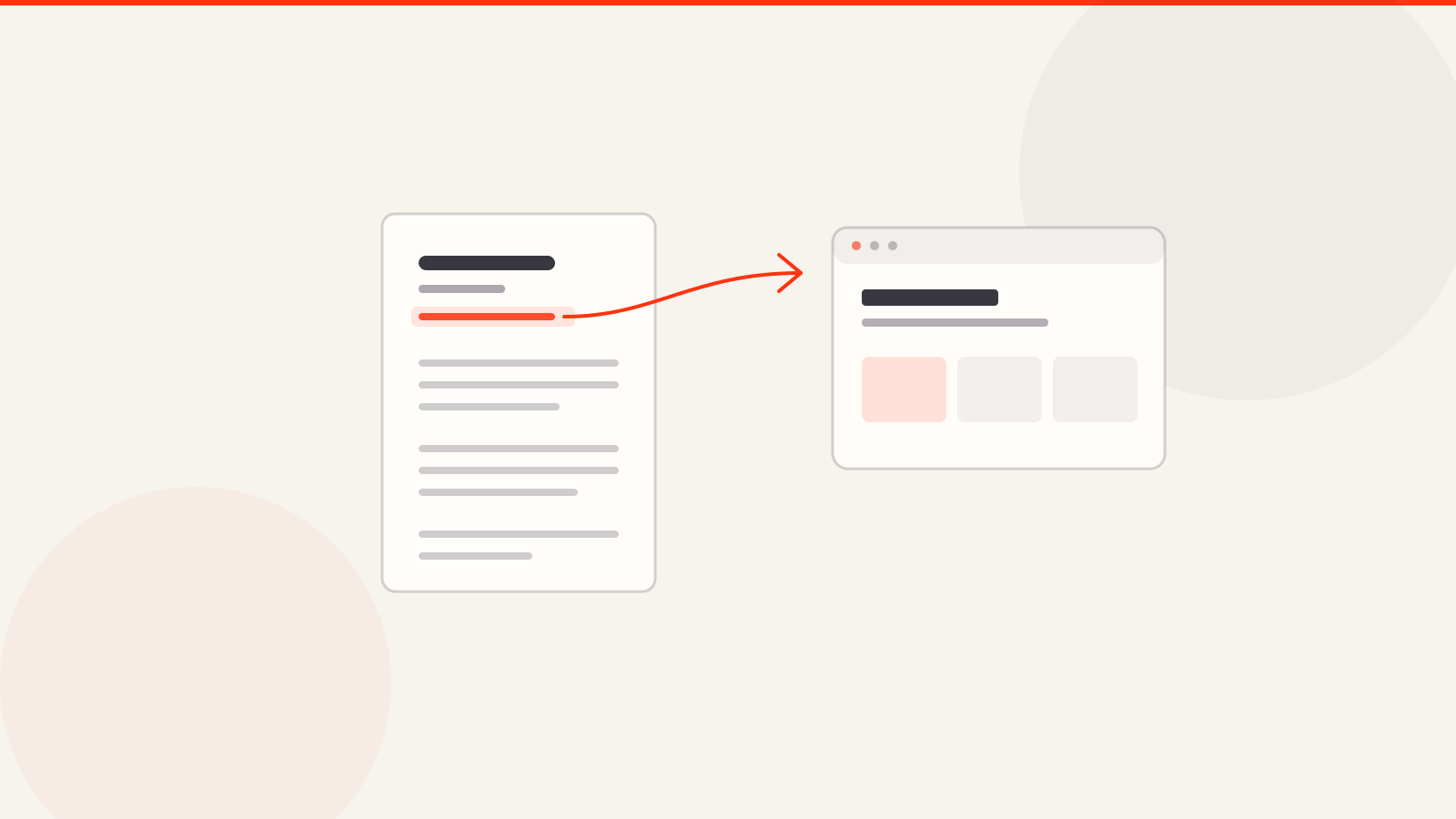
A resume summarises what you did; a portfolio shows the work behind it. Send a resume for every application, because most employers and applicant systems expect one. Add a portfolio when your work is visual, or when the decision rests on how you think rather than where you have worked. Most strong applications use both.
Almost every article answering this question is published by a company that sells portfolio websites, and they all reach the same conclusion: you need both. We also sell portfolio websites, so treat this with the appropriate suspicion — but the honest answer is that for a large number of roles, a portfolio changes nothing, and building one is time you could have spent on the resume that actually gets read.
This covers what each document is genuinely read for, how to tell which side your own field falls on, and what to do when the answer is "both."
Why do you need a portfolio?
You need a portfolio when a claim on your resume is easier to evaluate by seeing the work. A job title cannot show how you structure an argument, design a screen or solve a programming problem. A small, relevant project can make those decisions inspectable and give you something concrete to discuss in an interview. It does not guarantee an interview or replace a required CV.
| Your work | Useful evidence | What the reviewer should understand |
|---|---|---|
| Design | A selected screen and one explained revision | Your reasoning and personal contribution |
| Development | A working demo, code link or technical case study | What you built and how to inspect it |
| Writing | A short extract or permitted published link | Your audience, brief and editing decisions |
| Operations or analysis | An anonymized process example or analysis | The problem and the decision it informed |
From a CV claim to portfolio evidence — fictional illustration
CV claim: Built a scheduling prototype for a course project.
Portfolio evidence: Show the initial flow, a revised screen and a short explanation of the trade-off.
Your role: State which parts you completed yourself.
Outcome: Say what you learned; do not invent revenue or a conversion improvement.
If a vacancy only asks for a CV and you have no relevant work you can share, finish the CV first. If you have a class or personal project, label it accurately and use the no-client-experience guide. A useful starting point is one complete project, not an arbitrary number of thumbnails.
Choose the format after choosing the evidence. Compare portfolio website and PDF, or inspect ArcPixel, Lovable, Wix and Zety by task. For applications in France, the portfolio builder guide covers language and presentation checks.
They answer two different questions
A resume answers "is this person plausibly qualified?" It's a filtering document, read fast, often by someone screening dozens of applications who is looking for reasons to narrow the pile. Everything about its format — the compression, the reverse chronology, the standard section names — exists to make that judgment fast.
A portfolio answers "is this person actually any good?" It's an evidence document, read slowly, usually by someone who has already decided you're plausible and now wants proof before spending an hour interviewing you. It's read by fewer people, later, but with far more attention.
That difference explains why the advice "just make your resume longer and add screenshots" doesn't work. The two documents are read by different people at different moments for different reasons, and a document trying to do both jobs does neither well.
Which one your field actually needs
The useful question isn't "should I have a portfolio" in the abstract — it's whether the work you do produces artifacts a stranger can evaluate on sight. Some honest categories:
| If you work in | Portfolio is | Because |
|---|---|---|
| Design, illustration, photography, video | Effectively required | The work is visual; a resume literally cannot convey it |
| Front-end / product development | Strongly expected | Live projects and code are directly inspectable |
| Writing, content, journalism | Strongly expected | Published pieces are the whole evidence base |
| Architecture, interior, industrial design | Effectively required | Portfolio review is a formal part of hiring |
| Marketing, growth, product management | Helpful, not expected | Outcomes matter more than artifacts; a resume can carry numbers |
| Sales, operations, finance, HR | Rarely relevant | Performance is measured in results, not artifacts |
| Backend / infrastructure engineering | Optional | GitHub often substitutes; polished case studies rarely asked for |
| Students and career changers | Genuinely useful | It's evidence when the resume has little to show yet |
That last row is the one most often missed. A portfolio is at its most valuable precisely when your resume is at its weakest — no experience yet, or experience in a field you're leaving. It's the only document that lets you show capability you haven't yet been paid for.
A resume argues you're qualified. A portfolio removes the need to take your word for it.
What each one should not try to do
- A resume shouldn't try to be visual. Screenshots, skill rating bars, and heavy graphics cost space, break parsing, and don't substitute for the real thing being one click away.
- A portfolio shouldn't try to be complete. It's curated by definition — four strong projects beat eleven with three weak ones, because a reader judges you by the weakest thing you chose to show.
- A resume shouldn't omit an outcome because "it's on the portfolio." Plenty of readers never click. Anything essential belongs in both.
- A portfolio shouldn't repeat the resume in longer form. If a case study is just the bullet point with more adjectives, it adds nothing over the document that was already read.
If you need both, build them from the same facts
The practical failure mode when people maintain both isn't quality — it's drift. A role gets updated on one and not the other, a title is phrased slightly more senior in one place, dates shift by a month. A hiring manager comparing the two back-to-back notices, and the inconsistency reads as carelessness even when it's just neglect.
Whatever tools you use, keep one source of truth for the facts — roles, titles, dates, education — and treat both documents as views of it. The depth and audience should differ; the facts should not.
Where ArcPixel fits
ArcPixel offers resume and portfolio editors in the same account. Build each document for its reader, then verify that facts such as role dates and project outcomes agree. You can import information into the resume workflow; portfolio projects need their own review and editing. See the resume builder and plans for current capabilities.
If you've decided you need both, this guide covers turning one into the other without the drift, and this one covers connecting them — where the link goes and why it so often stops working.
- Do I need a portfolio if I already have a good resume?
- It depends entirely on whether your work produces something a stranger can evaluate on sight. For design, writing, front-end development, and architecture, a portfolio is close to required. For sales, finance, operations, and HR, it's rarely asked for and rarely read.
- Can a portfolio replace a resume?
- No. Nearly every formal application process requires a resume, and it's the document that gets read first and filtered on. A portfolio supplements it; it doesn't substitute for it.
- What's the difference between a CV and a portfolio?
- A CV is a longer, more complete career record — common in academia and in many countries as the standard term for a resume. A portfolio is a curated collection of actual work. The CV lists what you did; the portfolio shows it.
- How many projects should a portfolio have?
- Three to six strong ones. Readers judge you by the weakest project you chose to include, so adding a mediocre fourth to reach a round number actively lowers the impression.
- I'm a student with no work experience — portfolio or resume first?
- Start with the documents the application requires. A relevant course or personal project can support a student CV when you can show and explain the work honestly.
- Does a portfolio help for non-creative roles?
- Occasionally, and rarely in the traditional format. A product manager or marketer may benefit from one or two written case studies, but a gallery-style portfolio is the wrong shape for that work and usually isn't expected.
- Should my portfolio include everything on my resume?
- No — the resume is the complete record, the portfolio is the curated argument. It's normal to drop roles that don't support what you want the portfolio to demonstrate, as long as the resume itself stays complete.
- What's the most common mistake when keeping both?
- Drift. Dates, titles, or project scope that quietly stop matching between the two documents. It's the discrepancy a recruiter cross-checks fastest, and it reads as carelessness regardless of which one has the typo.
- Is LinkedIn enough instead of a portfolio?
- For roles where a portfolio isn't expected, usually yes. For roles where it is, no — LinkedIn largely restates your resume, so it adds the least new evidence of the three documents.
- How long should a portfolio case study be?
- Long enough to cover the problem, your approach, and the outcome — often a few hundred words plus visuals. Much shorter reads as a caption; much longer stops being read at all.
- Should I build the portfolio before applying, or as I go?
- Before, if the field expects one, because a link to an unfinished site does more damage than no link. Build one project completely rather than five partially.
- Do I need a custom domain for a portfolio?
- No. A clear subdomain can be enough; whether it is free depends on the builder. ArcPixel requires a paid plan to publish. A custom domain is a small polish signal, not a requirement, and matters far less than what the first screen shows.